The problem
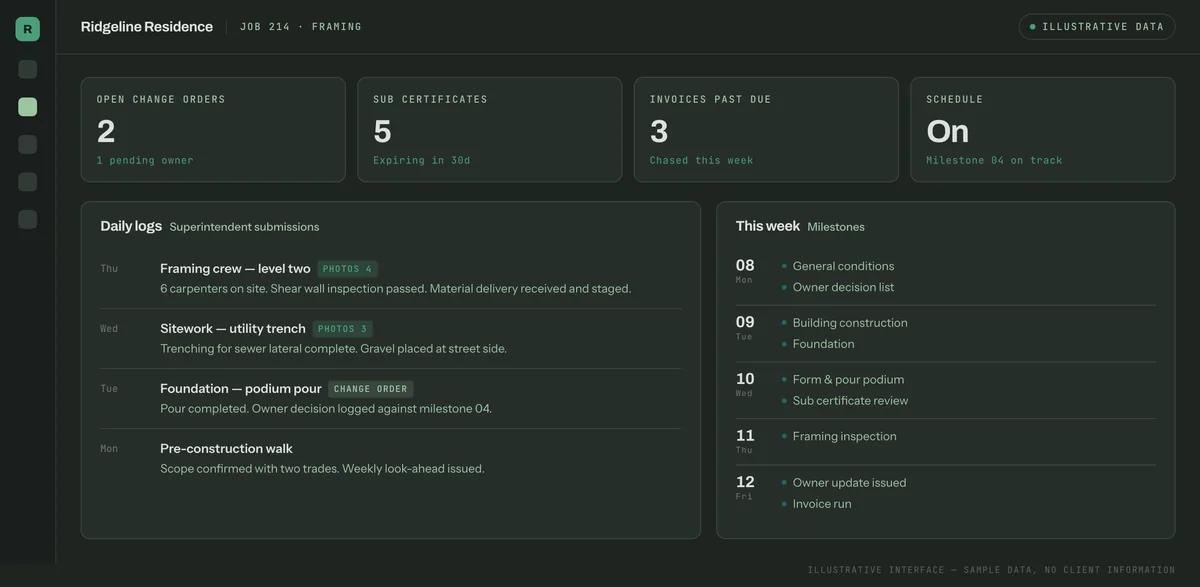
A residential build generates a continuous stream of small administrative obligations. Daily logs, subcontractor certificates with expiry dates, change orders awaiting owner decisions, invoices moving toward payment, allowance tracking against a budget that shifts weekly.
Each item is trivial. Collectively they decide whether a project stays profitable and whether the builder can answer a question three months later. The failure mode is not dramatic — it is a certificate that lapsed, a line item nobody categorised, an allowance quietly overspent.
What I did
Brought the recurring work into one predictable shape inside Buildertrend, so the same job produced the same artefacts every time regardless of who was doing it.
- Estimate structure. Line items categorised against a consistent scheme, so estimates could be compared across jobs instead of each being its own dialect.
- Allowance setup. Allowances configured and tracked so overruns surfaced while there was still time to have the conversation.
- Compliance documentation. Subcontractor certificates and required documents organised with expiry visible, rather than discovered during an audit.
- A coordinator's guide. The recurring procedures written down, so the role could be handed over without a week of shadowing.
Why the documentation mattered most
The estimating and allowance work made individual projects legible. The written guide is what made the role transferable.
Construction coordination is heavy on undocumented knowledge — which subcontractor needs chasing, what a particular owner wants to approve personally, which milestone always slips. Some of that is genuinely irreducible judgement. A surprising amount is just procedure nobody had bothered to write down.
What carried forward
This is where the pattern I now apply everywhere first became obvious to me: the bottleneck in a small operation is rarely capability, and almost always the fact that the process exists only as habit. The same instinct produced the intake system at ARC and the reporting platform at Lively — find the recurring work, write it down, then automate the parts that deserve it.
The interface above is an illustration built for this portfolio. Project names, people and figures are invented — no client or project information appears on this site.