The problem
Onboarding by apprenticeship has an obvious appeal and a hidden cost. What a new starter learns depends on who had capacity to teach them, so two reps hired a month apart receive materially different training — and nobody can say which parts either of them actually absorbed.
It also consumes the time of exactly the people you least want pulled off their own work.
What I built
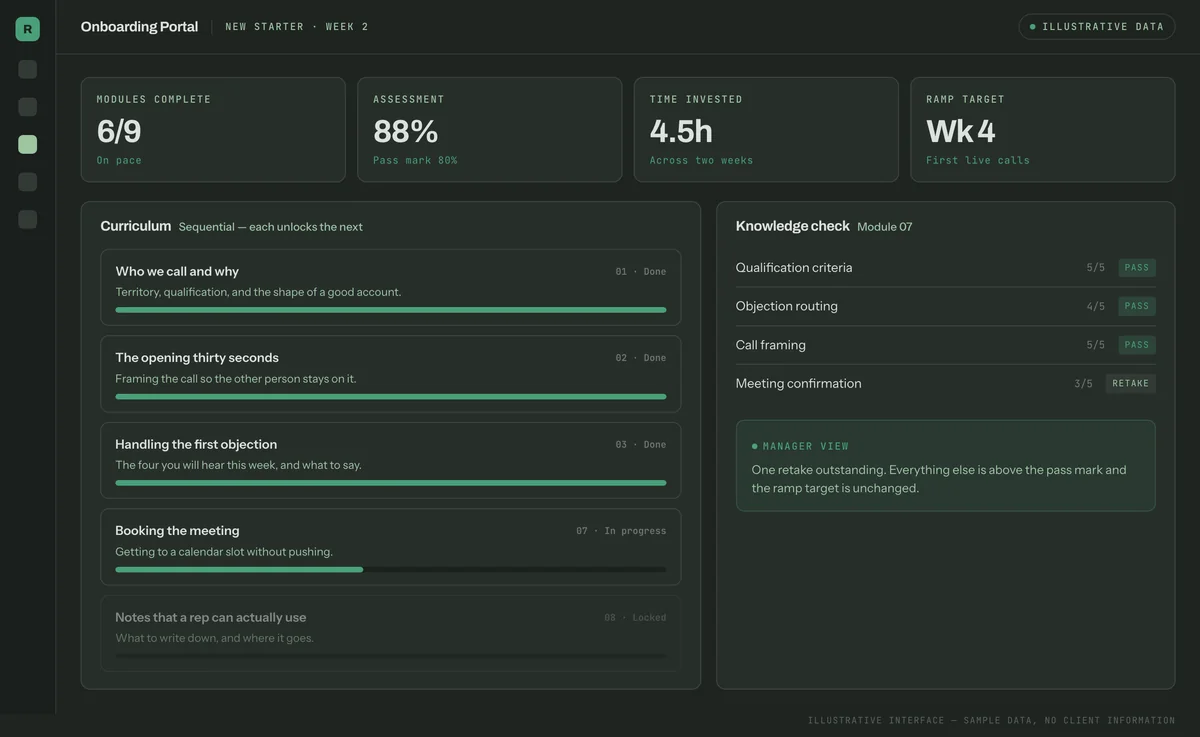
A self-serve training portal with a defined curriculum. Modules unlock in sequence, each ending in a knowledge check that has to be passed before the next opens.
The sequencing is the point. Objection handling before qualification produces a rep who argues with the wrong people; the order encodes how the job is actually learned, not just what there is to know.
Curriculum over software
The application is deliberately modest — React and Vite, module content in structured data, assessments alongside. That was the right call, because the difficulty was never technical.
The hard part was deciding what a new rep genuinely needs in week one versus what a manager merely enjoys explaining. Most training material fails by being comprehensive: it covers everything, so a new starter cannot tell what matters. Cutting it back to what changes behaviour in the first fortnight took considerably longer than building the portal that delivers it.
What it gives a manager
Visibility, mainly. Where each starter is, what they have passed, what needs retaking, and whether the ramp target is still realistic. That turns onboarding from an anecdote into something a manager can actually act on before it becomes a problem.
The interface above is an illustration built for this portfolio. Progress and results are invented — no personal or client information appears on this site.