The problem
A principal attorney's week is contested by everyone at once. Client consultations, internal reviews, networking commitments, vendor calls, filing deadlines, and a steady background of people who need ten minutes. Every one of those requests is reasonable in isolation.
Left to arrive first-come, the calendar fills with whatever was asked for earliest rather than whatever matters most. The predictable results: no gap between a meeting across town and the one after it, administrative work pushed to the evening because the day had no room for it, and a double-booking nobody notices until someone is already waiting.
The failure is rarely a missed meeting. It is that the highest-value work — the work only the attorney can do — gets whatever is left over.
How I structure the week
The calendar is treated as a budget rather than a queue. Some of it is spent before anyone gets to ask.
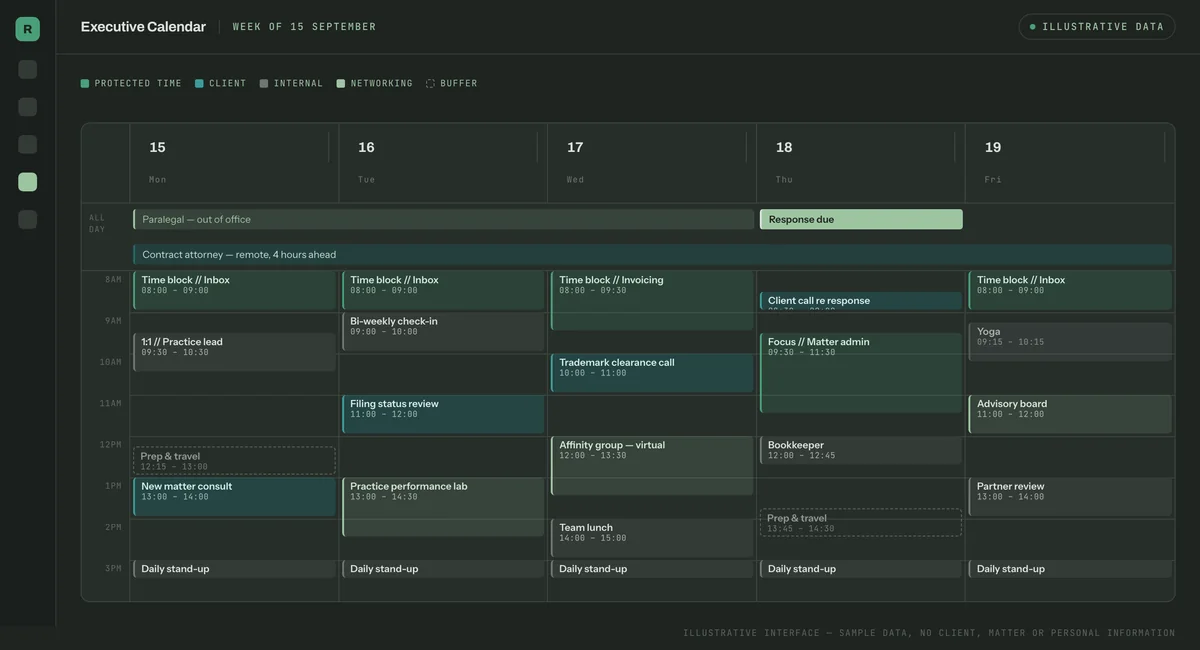
- Protected blocks. Recurring, defended time for inbox triage, invoicing and matter administration. Booked like a meeting, because time that is not on the calendar is time other people assume is free.
- Buffers. Prep and travel sit on the calendar as their own entries before anything external. A one o'clock across town starts at twelve-fifteen.
- Categories. Client, internal, networking, protected and buffer are visually distinct, so a glance answers “what kind of week is this” without reading a single title.
- Availability bands. Who is out, who is remote, who is working several hours ahead — across the top, where it informs scheduling instead of being discovered afterwards.
- Deadlines as fixtures. Filing and response dates sit in the all-day row from the moment they are known, so the days before them are visibly spoken for.
The judgement part
Structure handles the routine. The rest is triage, and it is the part that cannot be automated.
When two things collide, someone has to weigh which moves — against travel feasibility, who else is affected, whether the other party can reasonably be rescheduled, and what it costs the relationship. I make that call and present a recommendation rather than handing over a conflict.
The same applies to the inbox. Most of what arrives needs an answer, a delegation or a diary entry; only a fraction genuinely needs the principal's judgement. Sorting those is the job.
Why it holds
Because the rules are written down rather than held in my head. The categories, the buffer conventions, what gets protected and what may be moved — documented alongside the firm's other procedures, so someone covering for me schedules the week the way I would.
That is the same test I apply to everything else here. A calendar only I can run is not a system, it is a dependency.
The calendar above is an illustration built for this portfolio. Every name, meeting and deadline is invented — no client, matter or personal information from any firm appears anywhere on this site.