The problem
Thought leadership at a small firm fails in a predictable way. Someone decides the firm should be visible. Three good posts go out in a fortnight. Then a filing deadline lands, and nothing appears for two months.
Sporadic publishing is close to worthless, because none of it compounds. The audience never forms a habit, the firm never builds a beat it is known for, and the effort already spent is wasted rather than banked.
The bottleneck is never ideas. It is that drafting depends on the person with the least available time — the attorney whose expertise makes the writing worth reading.
What I do
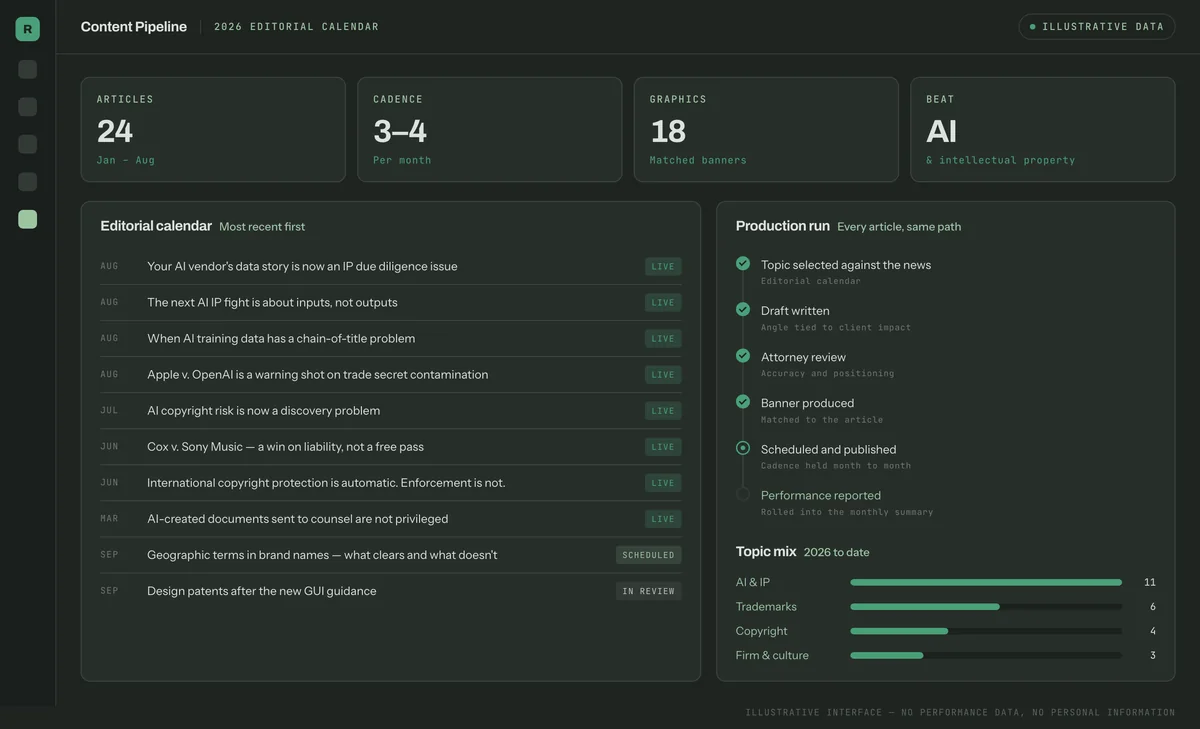
I run the programme end to end so the attorney's involvement is concentrated where only they can contribute: reviewing for accuracy and positioning.
- Topic selection against the news. An editorial calendar tracking rulings, agency guidance and disputes as they land, filtered to what the firm's clients would actually act on.
- Drafting. Each article written to a consistent shape — what happened, why it matters commercially, what a business should do about it.
- Attorney review. The one step that cannot be delegated, and the reason the rest is worth delegating.
- Production. A matched banner graphic per article, so the feed presence is recognisable rather than incidental.
- Publication and reporting. Scheduled to hold the cadence, with performance rolled into the monthly summary to leadership.
Choosing the beat
The programme concentrated on artificial intelligence and intellectual property, and that focus is what made it work.
It is where the firm's clients have live, unresolved questions, and where the law is moving fast enough that timely commentary has genuine value. It also rewards consistency: a reader who wants to understand how AI is reshaping IP risk has a reason to come back, which a general-interest legal feed never earns.
Pieces covered privilege over AI-generated documents, trade secret contamination between competitors, chain-of-title problems in training data, copyright exposure surfacing in discovery, and the shifting IP landscape in China — alongside the foundational trademark material a prospective client searches for.
Selected writing
Openings from three pieces, chosen for range rather than performance. Each was written for the firm and published under its byline — these are excerpts shown as writing samples, not republished articles.
Apple v. OpenAI Is a Warning Shot on Trade Secret Contamination
On July 10, 2026, Apple filed a trade-secret and breach-of-contract lawsuit in the Northern District of California against OpenAI, two former employees, and related entities tied to OpenAI’s hardware push. The case is at an early stage, and the allegations remain allegations. But for business leaders, that does not mean the dispute is only interesting if Apple ultimately wins.
What makes this filing important is the type of IP risk it highlights. For the last several years, AI legal commentary has focused heavily on copyright, training data, and model outputs. Those issues still matter. But the Apple complaint is a reminder that the next major AI IP problem for some companies may look less like a copyright theory and more like trade secret contamination.
AI-Created Documents Sent to Counsel Are Not Privileged, Federal Judge Rules
A recent federal court decision from the Southern District of New York has delivered a clear message about the limits of attorney-client privilege in the age of artificial intelligence. In United States v. Heppner, a district court held that documents a client generated using a commercial AI tool and later shared with his attorneys were not protected by attorney-client privilege or the work-product doctrine.
The case involved a financial services executive facing federal fraud charges who used an AI tool to create a series of documents related to his legal defense. Even though the client shared those materials with his lawyer, the court agreed with the government that privilege did not apply.
Why Trademark Clearance Should Happen Before You Launch
Launching a new brand is exciting. You have invested time, money, and creativity into your name, logo, and messaging, and you are ready to go to market.
But one of the most common — and costly — mistakes we see is skipping trademark clearance before launch. In today’s fast-moving, digital-first environment, failing to clear a brand name early can expose businesses to unnecessary risk, expense, and disruption.
What made it hold
Twenty-four articles between January and August, at three to four a month. The number matters less than the fact that the cadence survived busy months, which is exactly where these programmes normally die.
It survived because it stopped being a creative act performed when someone felt inspired and became a production run with defined steps and a named owner at each one. Same path every time. That is the whole trick, and it is the same one behind the intake system and the reporting platform on this site.
The pipeline above is an illustration built for this portfolio. It shows no performance figures and no personal data — audience and engagement metrics belong to the firm and its people, not to a portfolio.