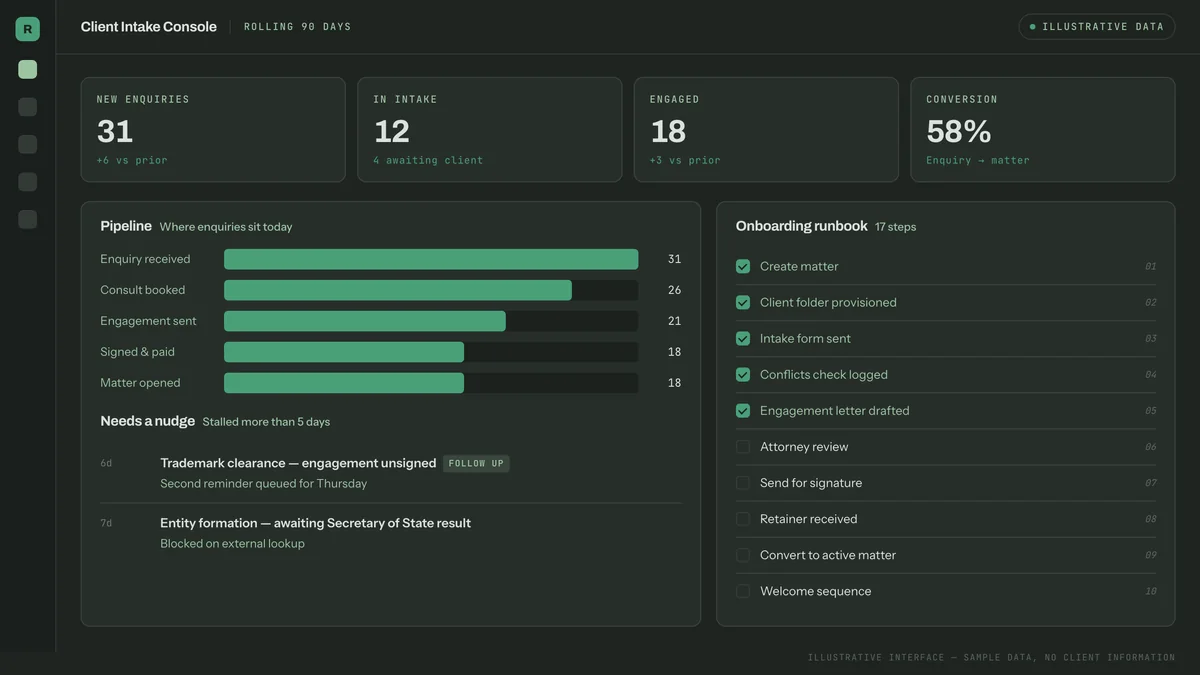
The problem
Intake at a small firm is deceptively hard. A prospective client emails, calls, or arrives through a referral. Somebody books a consultation. Somebody else drafts an engagement letter. A retainer needs collecting, a conflicts check needs running, an entity needs verifying with the Secretary of State, and a matter needs opening in a different system than the one the enquiry arrived in.
None of that is difficult. All of it is forgettable. And when a step is forgotten, the failure is silent — the enquiry simply goes quiet, and nobody notices until the month-end review asks why the pipeline looks thin.
The firm had capable people. What it did not have was a written answer to “what happens next, and who does it.”
What I built
A single onboarding chain covering every step from first contact to an open, funded matter — sequenced, owned, and documented well enough that someone who had never done it could run it correctly on their first attempt.
- 01Create the matter and log the enquiry source
- 02Provision the client folder against a fixed structure
- 03Send the intake form and record what came back
- 04Verify the entity where the client is a company
- 05Prepare the engagement letter and disclosures
- 06Route to the assigned attorney for review
- 07Send for signature and track the retainer
- 08File executed documents back to the client folder
- 09Convert the record into an active matter
- 10Trigger the welcome sequence and first follow-up task
Seventeen steps in total. Each one names the tool, the owner, and the trigger for the step after it — so the process moves without anyone holding the whole thing in their head.
How it holds together
The chain spans four systems that do not natively talk to each other, so the documentation is the integration. Clio Grow holds the enquiry, Clio Manage holds the matter, DocuSign carries the signature, LawPay carries the retainer, and Dropbox holds the file. The runbook defines the handoff at every boundary, including what “done” looks like before the next step is allowed to start.
Around it sits a set of companion procedures for the work that recurs: inbox triage rules that sort what needs an attorney's judgement from what needs an assistant's, continuing-education compliance tracking, and expense entry against the right matter.
Where AI actually helps
I use it where it removes genuine work rather than where it demonstrates well. Reviewing an executive inbox and surfacing what needs a decision. Turning a long thread into a short summary with the action items pulled out. Drafting the routine correspondence that follows a predictable shape. Researching a prospective client or organisation ahead of a meeting.
The pattern that made these stick was writing them as reusable workflows rather than one-off prompts — so the output is consistent enough to trust, and someone other than me can run them.
What changed
The measurable part is not speed, it is survivability. Before, the process lived in the head of whoever had done it last. Now it exists as a document, which means it can be delegated, audited, improved, and handed to a new starter.
The follow-up tracking is the part I would keep if I could only keep one thing. Enquiries do not stall silently any more, because “waiting on the client” is a state the system knows about rather than something a person has to remember.
The interface above is an illustration built for this portfolio. It shows the shape of the work, not the firm's data — no client information appears anywhere on this site.